You might be wondering why a crown is necessary, whether the procedure will hurt, or how much it will cost.
A dental crown, sometimes called a tooth cap, is a custom-made restoration that fits over a prepared tooth. It can help restore the tooth's shape and chewing function while protecting remaining tooth structure.
However, not every damaged tooth needs a crown. Some teeth can be restored with a filling, while others may require additional treatment before a crown can be considered.
At Dental Suite, we offer PFM, zirconia and E-max crowns.
This guide explains when crowns may be recommended, how the materials differ, what happens during treatment and how to care for your crown afterwards.
Guide
What Is a Dental Crown?
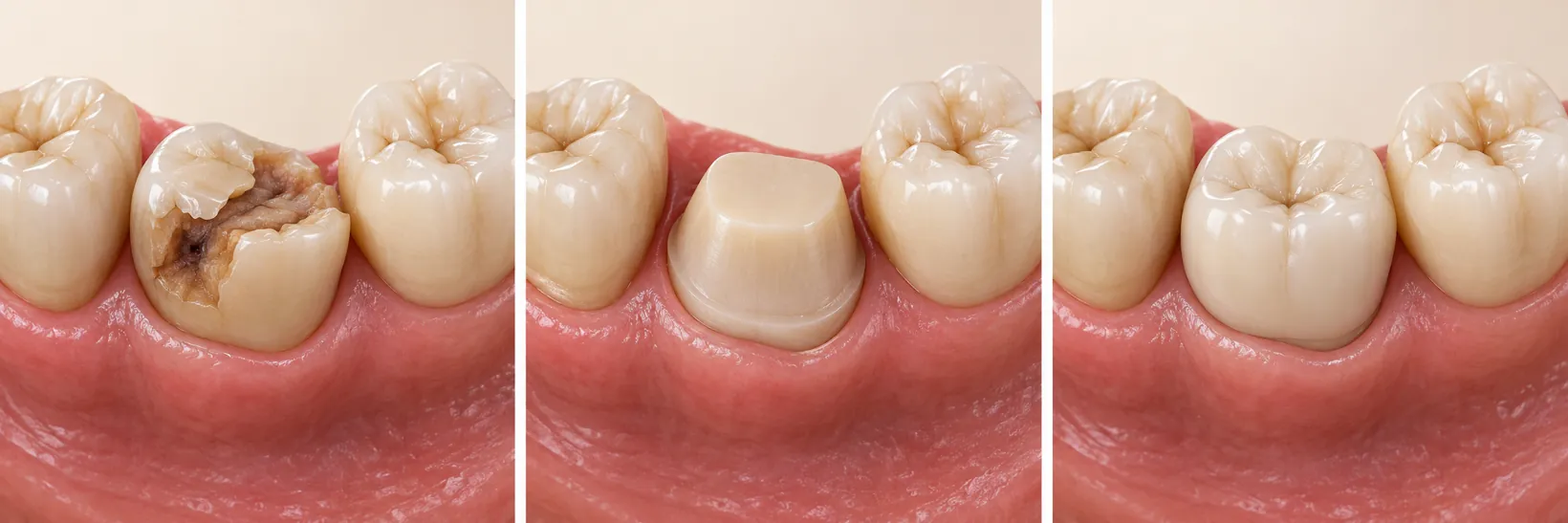
A dental crown is a tooth-shaped covering that fits over most or all of the visible portion of a prepared tooth.
It is designed to restore the tooth's shape and function, particularly when a large part of its natural structure has been damaged or lost.
To fit a crown, the dentist usually needs to prepare the remaining tooth by removing decay, adjusting its shape and creating enough space for the restoration.
The crown is then secured onto the prepared tooth using an appropriate dental cement or bonding technique.
Does getting a crown mean removing the entire tooth?
No. When a crown is placed on a natural tooth, the tooth and its root remain in your mouth.
The crown covers the prepared part of that tooth. It is different from a dental bridge, which replaces one or more missing teeth.
Damaged tooth → Prepared tooth → Crown fitted
A crown can restore and protect a tooth, but it does not replace treatment for underlying problems such as untreated decay, gum disease or an infected dental pulp.
Your dentist will assess these problems before recommending a crown.
Guide
When Might You Need a Dental Crown?
A crown may be recommended when a tooth has lost too much structure to be restored predictably with a conventional filling.
Common situations include:
1. A Tooth with a Large Filling
When a large filling occupies much of the tooth, the surrounding natural tooth structure may become weakened.
A crown may help protect the remaining tooth and restore its chewing surface.
2. A Cracked or Broken Tooth
If a tooth has fractured or developed a crack, a crown may sometimes help hold and protect the remaining structure.
However, this depends on how deep the crack extends and whether the tooth can still be restored.
A crack extending into the root may make the tooth unsuitable for a crown.
3. A Back Tooth After Root Canal Treatment
Molars and premolars often experience substantial chewing forces.
When these teeth have also lost significant structure through decay, fractures or previous fillings, a crown may help protect them from further damage.
Not every tooth that has undergone root canal treatment automatically requires a crown.
4. A Severely Worn Tooth
Teeth can wear down because of grinding, clenching, erosion or other causes.
A crown may be considered when a worn tooth needs restoration, although the underlying cause of the wear must also be assessed.
5. As Part of a Dental Bridge
Some dental bridges use crowns fitted over neighbouring teeth to support an artificial tooth that fills a gap.
This is different from placing a single crown on a damaged natural tooth.
Guide
When Might a Crown Not Be the Right Treatment?
A crown is not always necessary.
Your dentist may recommend another approach if:
The cavity or damaged area is small enough for a filling.
Untreated tooth decay or gum disease needs attention first.
The tooth's pulp is infected and root canal treatment is necessary.
The remaining tooth structure cannot adequately support a crown.
A crack extends so deeply that the tooth cannot be predictably restored.
In some situations, a less extensive restoration may preserve more natural tooth structure.
The dentist will explain which options are appropriate after examining your tooth and, when necessary, taking an X-ray.
Guide
Crown, Filling, Veneer or Bridge: What's the Difference?
Although these treatments can involve tooth-coloured materials, they serve different purposes.
Treatment
Main Purpose
Dental Suite Fees
Filling
Repairs smaller areas of decay or damage
RM100–RM250
Crown
Restores and covers a damaged tooth
RM900–RM2,200 per tooth
Veneer
Changes the appearance of the front surface of a tooth
RM400–RM2,200 per tooth
Bridge
Replaces missing teeth using a fixed restoration
Priced per unit and design
A filling replaces a damaged portion of the tooth.
A crown covers a larger part of the existing tooth.
A veneer is mainly used to change the appearance of the visible front surface of a tooth.
A bridge replaces a missing tooth rather than simply covering an existing tooth.
The appropriate treatment depends on your tooth's condition, not just its appearance.
PFM, Zirconia and E-max Crowns: What's the Difference?
Dental Suite offers three crown materials.
Each has different characteristics involving appearance, strength, tooth preparation and suitability for different areas of the mouth.
1. PFM Crowns (Porcelain Fused to Metal)
A PFM crown has a metal structure covered with tooth-coloured porcelain.
The metal provides structural support, while the porcelain gives the crown a tooth-coloured appearance.
What to know:
Combines a metal framework with a porcelain outer layer.
May be used for suitable front or back teeth.
The porcelain layer can chip under certain conditions.
A dark metal edge may become visible near the gumline, particularly if the gums recede.
Price: RM900–RM1,400 per tooth
2. Zirconia Crowns
Zirconia is a tooth-coloured ceramic material with high mechanical strength.
It is commonly considered for teeth that experience significant chewing forces, although suitability depends on the particular zirconia material and crown design.
What to know:
Metal-free ceramic material.
Can be used for selected front and back teeth.
Different zirconia formulations have different levels of translucency and strength.
Material choice must take into account your bite and the remaining tooth structure.
Price: RM1,400–RM1,800 per tooth
3. E-max Crowns
E-max is a lithium-disilicate glass-ceramic material.
It has optical properties that can produce a tooth-like appearance, making it an option for restorations where appearance is an important consideration.
What to know:
Metal-free glass-ceramic.
Can offer a translucent appearance similar to natural teeth.
Often considered for front teeth.
May also be used for suitable back teeth, depending on the clinical situation.
Requires appropriate tooth preparation and bonding or cementation.
Price: RM1,800–RM2,200 per tooth
Which Crown Is Suitable for Front Teeth or Back Teeth?
For front teeth, the dentist may place greater emphasis on matching the shape and colour of neighbouring teeth.
For back teeth, the forces involved in chewing may be an important consideration.
However, material selection is not determined by tooth position alone.
Your dentist will also assess:
How much healthy tooth structure remains.
Your bite and chewing habits.
Whether you grind or clench your teeth.
The appearance you want to achieve.
The clinical requirements of the chosen material.
Compare PFM, Zirconia and E-max Crowns
PFM
Zirconia
E-max
Made of
A metal framework with a porcelain outer layer
A tooth-coloured ceramic material with high mechanical strength
A lithium-disilicate glass-ceramic
Contains metal
Yes
No
No
Appearance
Tooth-coloured porcelain; a dark metal edge may become visible near the gumline if the gums recede
Translucency varies between zirconia formulations
Can offer a translucent appearance similar to natural teeth
Can be used for
Suitable front or back teeth
Selected front and back teeth
Often considered for front teeth; suitable back teeth depending on the clinical situation
Things to know
The porcelain layer can chip under certain conditions
Material choice must take into account your bite and the remaining tooth structure
Requires appropriate tooth preparation and bonding or cementation
Fee per tooth
RM900–RM1,400
RM1,400–RM1,800
RM1,800–RM2,200
Material selection is not determined by tooth position alone.
Guide
What Happens During Crown Treatment at Dental Suite?
Dental Suite currently plans crown treatment over two treatment visits.
If the tooth requires additional treatment, such as root canal treatment or gum care, this may need to be completed beforehand.
1
Visit 1: Examination and Tooth Preparation
Your dentist examines the tooth and surrounding gums.
An X-ray may be needed to assess the roots and surrounding bone.
If a crown is appropriate, the dentist will explain the proposed treatment and obtain your agreement before proceeding.
Local anaesthetic may be used to make tooth preparation more comfortable.
The dentist will remove any decay and prepare the tooth to provide sufficient space and support for the crown.
An impression or digital scan is then taken so the restoration can be made to fit your tooth.
The dentist will also discuss a suitable crown shade.
2
Temporary Crown
A temporary crown is usually fitted over the prepared tooth while the final crown is made.
It helps protect the tooth and maintain its appearance during the waiting period.
However, a temporary crown is not intended to withstand the same demands as the final restoration.
3
Laboratory Stage
The dental laboratory makes your crown using the records taken during the preparation visit.
Usual laboratory turnaround: 1–2 weeks
4
Visit 2: Fitting Your Final Crown
At the second visit, the temporary crown is removed.
Your dentist checks the final crown's fit, contact with neighbouring teeth, bite and appearance.
Once the fit is acceptable, the crown is secured using the appropriate technique.
Small adjustments may be needed to ensure it feels comfortable when biting.
Additional visits may be necessary if the crown requires further modification or other dental problems need attention.
Guide
How to Care for Your Temporary Crown
Until the final crown is fitted:
Avoid very hard or sticky foods that may damage or loosen the temporary crown.
Try to chew on the opposite side if possible.
Brush carefully around the temporary crown.
If advised to floss, gently slide the floss out sideways rather than pulling it upwards.
Contact the clinic if the crown becomes loose or comes off.
If the temporary crown falls out, keep it and contact your dentist.
Do not attempt to reattach it with household glue.
Guide
Does Getting a Dental Crown Hurt?
The level of discomfort depends on the condition of your tooth and the preparation required.
When local anaesthetic is used, the area should be numb during tooth preparation. You may still notice pressure or vibration.
Afterwards, some people experience temporary gum tenderness or tooth sensitivity, particularly to cold drinks.
This usually improves, although the duration varies.
Contact the clinic if you experience:
Increasing or severe pain.
Swelling.
Persistent sensitivity.
A crown that feels unusually high when biting.
A loose or damaged temporary crown.
A crown that feels too high may require a bite adjustment.
Guide
Do You Need a Crown After Root Canal Treatment?
Not every tooth that has undergone root canal treatment needs a crown.
The decision depends on which tooth was treated, how much healthy tooth structure remains and how much pressure the tooth experiences during chewing.
Back Teeth
Molars and premolars often carry stronger chewing forces.
If a back tooth has lost significant structure through decay, fractures or previous fillings, a crown may be recommended to help protect the remaining tooth.
Front Teeth
A front tooth that still has sufficient healthy structure may sometimes be restored with a filling rather than a crown.
Your dentist will assess the tooth before recommending the final restoration.
What Is a Post and Core?
When a root-canal-treated tooth has lost a large amount of its upper structure, additional support for the restoration may be needed.
A core rebuilds the missing portion of the tooth so the crown can be retained.
A post may be placed within a prepared root canal to help retain that core when there is insufficient tooth structure.
A post does not strengthen the tooth itself, and not every root-canal-treated tooth needs one.
Your dentist will determine whether a post and core is appropriate based on the remaining tooth structure.
Post and core fee: RM400, when required.
How Much Might the Complete Treatment Cost?
When a tooth needs root canal treatment and a crown, the total cost may involve several procedures:
Root canal treatment + post and core (if necessary) + crown
Consultation, X-rays and other required treatments may incur additional charges.
Estimate Root Canal and Crown Costs
Choose the tooth and crown material. Add post and core if your dentist says little tooth structure is left.
Which tooth?Crown material
Estimated total for one toothRM2,300–RM3,400
The calculator provides a fee estimate, not a diagnosis or confirmation that every procedure is necessary.
Guide
How Much Does a Dental Crown Cost at Dental Suite?
Crown fees depend on the material selected and the treatment required.
Crown Treatment Fees
Treatment
Fee
PFM crown
RM900–RM1,400 per tooth
Zirconia crown
RM1,400–RM1,800 per tooth
E-max crown
RM1,800–RM2,200 per tooth
Post and core, if required
RM400
Crown removal or repair
RM100–RM500
Dental examination and consultation
RM40–RM100, charged separately
X-rays and additional treatment, when required, may be charged separately.
Why Can the Final Cost Vary?
The total fee depends on:
The crown material.
The number of teeth being treated.
Whether root canal treatment or a post and core is needed.
Whether decay or gum problems require treatment first.
Any additional investigations or procedures.
The dentist will explain the proposed treatment and provide the applicable fees before you decide whether to proceed.
What's Included in the Crown Fee?
The quoted crown fee includes the impression or intra-oral scan, laboratory fabrication, a temporary crown and the final fitting appointment.
Are Crown and Bridge Prices the Same?
Not necessarily.
Although some bridges contain crown units, bridges are priced according to their material, design and number of units.
Dental Suite also offers fibre-reinforced composite (FRC) bridges, which have a separate fee range.